AIAA Regional Student Conferences · 2026
Optimal Powered-Descent Guidance
I co-authored a Rust-based study comparing zero-order-hold and Chebyshev-Gauss-Lobatto formulations for losslessly convexified powered descent.
Expanded technical stack
Overview
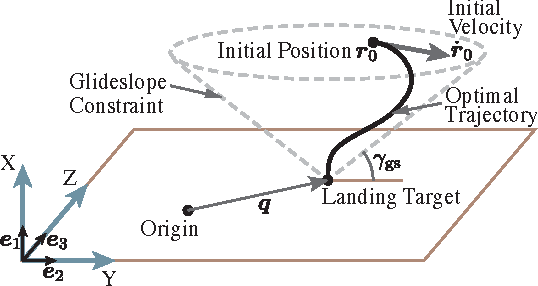
Lossless convexification relaxes the nonconvex minimum-thrust and pointing constraints of soft landing while preserving the optimum. Our team needed to choose a numerical formulation suitable for onboard path planning.
My contribution
I co-authored the paper and implemented work for the three-degree-of-freedom Rust guidance study, comparing time-discretized zero-order hold with a Chebyshev pseudospectral formulation.
Challenge
We needed to choose between a sparse, locally coupled ZOH discretization and a smaller but globally coupled Chebyshev formulation for real-time, fuel-aware VTVL descent planning.
Technical approach
We benchmarked both solvers across four 50-meter descent profiles and four resolution levels, comparing solve time, position and thrust RMSE, and maximum thrust-rate behavior against a high-resolution ZOH reference.
Result / outcome
At useful coarse resolutions, our study found that the Chebyshev-CGL formulation produced more accurate trajectories and substantially smoother controls than ZOH. Achieving higher trajectory and control quality with coarser discretization creates a stronger trade between numerical burden and solution quality, making the formulation well suited to onboard real-time powered-descent optimization. Based on these results, our team selected Chebyshev-CGL as the primary path-planning approach for the powered lander.